Process architecture.
Map the standard flow, variants, parallel work, wait states, loops, dependencies, handoffs, and completion criteria.
01 / Services / Complex Process & Responsibility Map
A detailed operating map for workflows that cross people, departments, systems, locations, approvals, exceptions, and external parties.
Complicated work becomes a usable model of sequence, decision rights, handoffs, inputs, outputs, authority, variants, failure points, and dependencies.
Complex Process & Responsibility Map / Starting at $5,00002 / Buyer outcome

The map gives operators, leaders, implementers, and reviewers a common view of how work actually moves and where responsibility changes hands.
03 / Operating signals
04 / Three core components
The product is not a diagram. It is three connected models — how the work moves, who holds authority over it, and what happens when the standard path stops.
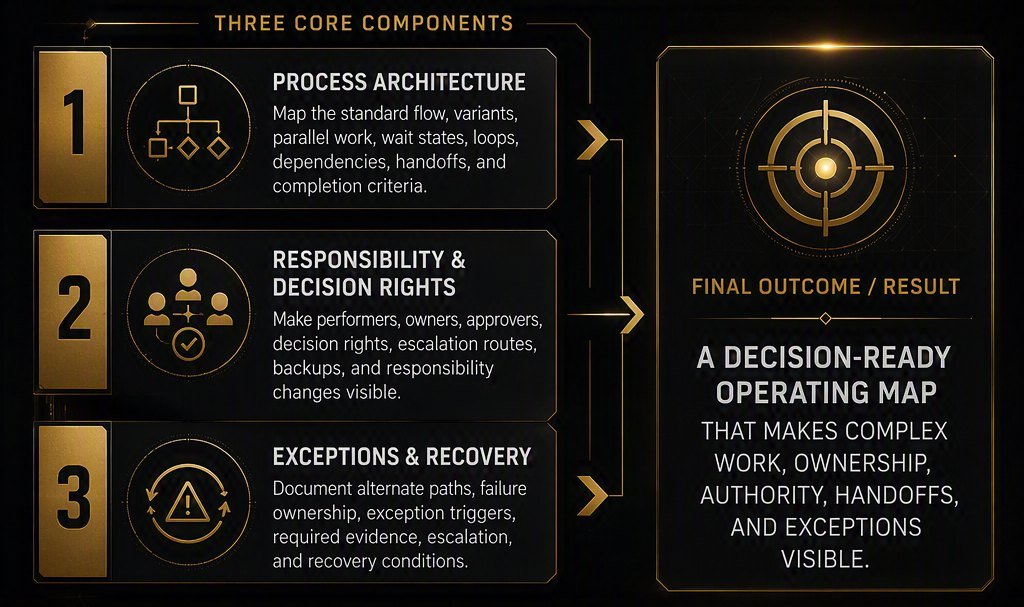
Map the standard flow, variants, parallel work, wait states, loops, dependencies, handoffs, and completion criteria.
Make performers, owners, approvers, decision rights, escalation routes, backups, and responsibility changes visible.
Document alternate paths, failure ownership, exception triggers, required evidence, escalation, and recovery conditions.
05 / The operating problem
Most process maps show a clean happy path. Complex operations do not stay on the happy path. They branch, wait, escalate, fail, recover, and require different authority depending on the condition.
This service models the full operating picture: what triggers work, who receives it, what information is required, which system is authoritative, who can decide, what happens when normal stops, and how the work closes.
The result is a decision-ready map that can support training, audit readiness, redesign, technology work, capacity improvement, and accountability.
06 / What becomes visible
Triggers, inputs, outputs, completion criteria, exclusions, and the boundary between this process and the next.
Normal work, alternate routes, repeated loops, batching, parallel work, wait states, and re-entry points.
Performers, owners, approvers, decision rights, escalation rights, backups, and separation of duties.
Department, location, system, vendor, customer, and other moments where work or information changes hands.
Required information, system of record, re-entry, evidence, retention, and information lost between steps.
What happens when the standard path stops, the decision changes, the data is incomplete, or the work must be recovered.

07 / Method
08 / The deliverable

09 / Use cases
Understand what must be preserved, what can change, and which dependencies make redesign risky.
Connect software requirements to actual work, authority, data, exceptions, and completion evidence.
Give new and cross-trained staff a usable model of the standard path and the conditions that change it.
Make ownership, escalation, decision rights, and handoffs visible enough to manage.
10 / Service ladder
11 / Clear boundaries
The map represents the agreed process and evidence. The customer remains responsible for approving, operating, and maintaining its work.
Redesign, SOP development, system implementation, training, and capacity work can be separately scoped from the map.
12 / The investment
Scope varies with workflow depth, process variants, locations, systems, stakeholders, decision points, exception paths, evidence, and reporting depth.
// COMPLEX WORK / CLEARLY MAPPED / CONFIDENTLY MANAGED
13 / Common questions
The core product is the operating map and responsibility model. SOP development can be separately scoped or included when explicitly agreed.
Yes — and on a complex process they are usually the point. Exception triggers, alternate paths, failure ownership, required evidence, escalation, and recovery conditions are one of the three core components, not an appendix.
Yes. Systems of record, manual re-entry, information dependencies, and system handoffs can be included in scope.
That disagreement is a finding, not an obstacle. The map is reviewed with the people who operate it, and unresolved disagreement is recorded rather than quietly settled in favor of the loudest account.
The cross-functional map is built for work crossing a manageable number of team boundaries. This product adds high-branching decision logic, formal decision rights, variants, exception and recovery paths, and dependency modeling — for processes that have become too important to guess at.
Workflow count, depth, variants, sites, stakeholders, historical analysis, field observation, and reporting requirements.
14 / The decision
Bring the process that crosses too many people, systems, decisions, and exceptions to explain easily.
Start the conversation →Starting at $5,000 Decision-ready map
Talk to us