01 / Services / Controlled Operations System

A manual explains the work. A controlled system governs how it stays reliable.
Build the operating home.

A done-for-you operating-system engagement connecting authority, process, controls, evidence, review, exception, and improvement.

JLS builds the governed structure around the way the organization actually works. You keep the approvals and responsibilities that must remain yours.

Controlled Operations System / Starting at $22,500

02 / Three core components

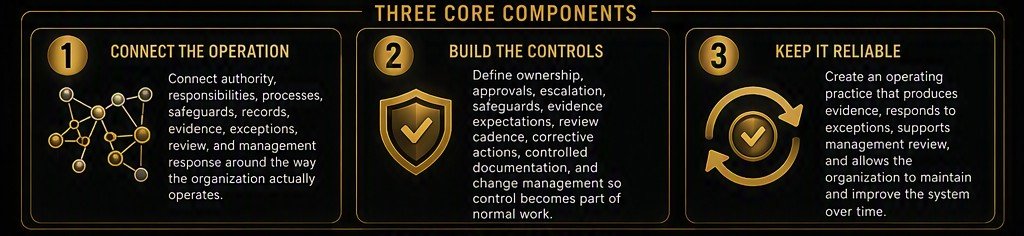
Three core components. One, connect the operation: connect authority, responsibilities, processes, safeguards, records, evidence, exceptions, review and management response around the way the organization actually operates. Two, build the controls: define ownership, approvals, escalation, safeguards, evidence expectations, review cadence, corrective actions, controlled documentation and change management so control becomes part of normal work. Three, keep it reliable: create an operating practice that produces evidence, responds to exceptions, supports management review, and allows the organization to maintain and improve the system over time.

The system turns responsibilities, controls, evidence, review, and improvement into a connected operating practice instead of a shelf document.

03 / Operating signals

03Core
components
06Operating
dimensions
06Method
stages
01Governed
system

04 / The operating problem

The system must fit the way the company actually operates. Make control practical.

Organizations do not need another disconnected binder. They need a system that names authority, shows how work moves, defines controls, produces evidence, responds to exceptions, and gives management a way to see whether the system is working.

This is the done-for-you version: discovery, architecture, documentation, control structure, evidence model, implementation support, and a usable handoff within the defined scope.

Control that sits outside normal work gets skipped under pressure. Control built into normal work survives it.

05 / The operating home

Four questions at the centre. Everything else connects to them.

Authority, process, evidence, and review sit at the core. Inputs feed them; outputs route from them. The organization’s real operation becomes a connected system — active, accountable, and built to keep improving.
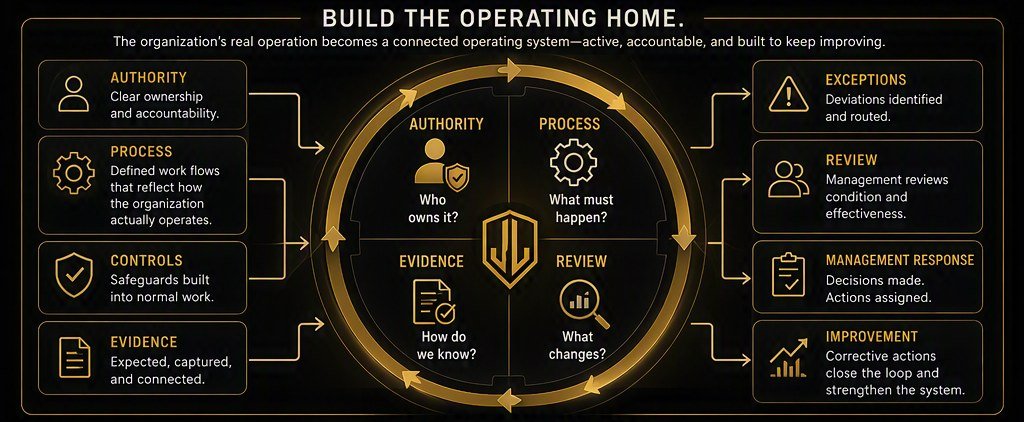
Build the operating home. The organization's real operation becomes a connected operating system: active, accountable, and built to keep improving. Inputs on the left are authority with clear ownership and accountability, process with defined workflows that reflect how the organization actually operates, controls as safeguards built into normal work, and evidence that is expected, captured and connected. At the centre four questions: authority, who owns it; process, what must happen; evidence, how do we know; review, what changes. Outputs on the right are exceptions with deviations identified and routed, review where management reviews condition and effectiveness, management response where decisions are made and actions assigned, and improvement where corrective actions close the loop and strengthen the system.
Inputs → four core questions → exceptions, review, response, improvement.

06 / Operating dimensions

Build control around the way the company works. Keep the system connected.

Six operating dimensions. Leadership: authority and accountability drive the system. Participation: operator input and feedback strengthen outcomes. Risk: failure points identified and controlled. Assurance: evaluation and improvement keep the system reliable. Document: one controlled record of how the system works. Coordination: internal and external responsibility connected.
// 01 / LEADERSHIP

Authority and accountability.

Ownership, delegated authority, approvals, escalation, resources, backups, and management review.

// 02 / PARTICIPATION

Operator input and feedback.

Capture the knowledge of people performing the work and create issue-reporting paths for controlled improvement.

// 03 / RISK

Failure points and controls.

Identify hazards, failure conditions, non-routine work, critical dependencies, and controls appropriate to the condition.

// 04 / ASSURANCE

Evaluation and improvement.

Define review cadence, measures, corrective actions, exception review, and controlled changes.

// 05 / DOCUMENT

One controlled record.

Versioning, ownership, approval, distribution, retained records, and clear current information.

// 06 / COORDINATION

Internal and external responsibility.

Clarify communications and boundaries among leaders, workers, contractors, vendors, customers, and partners.

07 / How the system runs

A system that produces evidence can be improved. One that does not, cannot.

The loop is the product. Real work becomes a governed system; the governed system produces operating evidence; evidence surfaces exceptions; exceptions drive controlled improvement that strengthens the system. Break any link and the system decays back into habit.
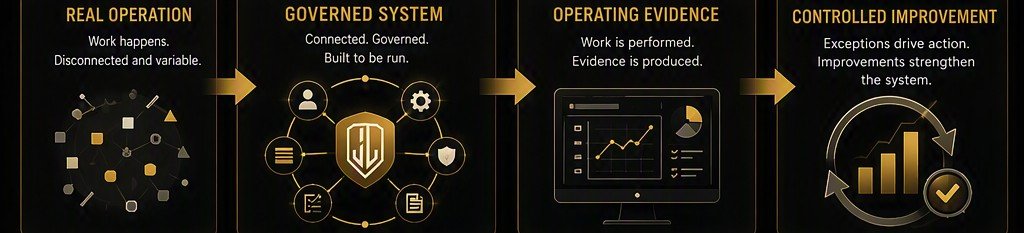
Four stages. Real operation: work happens, disconnected and variable. Governed system: connected, governed, built to be run. Operating evidence: work is performed and evidence is produced. Controlled improvement: exceptions drive action and improvements strengthen the system.
Real operation → governed system → operating evidence → controlled improvement.

08 / Method

Discover the operation, then build the system that makes control routine. Leave it usable.

01 / DISCOVERUnderstand
02 / ARCHITECTConnect
03 / BUILDDocument
04 / ENABLEImplement
05 / VERIFYReview
06 / TRANSFERHand off
  • Discover. Understand the organization, people, processes, risks, systems, controls, obligations, and existing material.
  • Architect. Connect authority, work, safeguards, evidence, training, change, review, exception, and management response.
  • Build. Produce the controlled documentation, records, registers, procedures, and operating structure.
  • Enable. Support defined implementation, communication, training references, and ownership transfer.
  • Verify. Review readiness, evidence, unresolved work, customer-owned actions, and maintenance needs.

09 / The deliverable

A governed system people can run. Not a binder that waits.

  • Operating-system architecture. Domains, ownership, requirements, controls, evidence, dependencies, and management review.
  • Responsibility model. Roles, authority, approvals, escalation, backups, participation, and decision rights.
  • Controlled documentation set. Policies, SOPs, work instructions, forms, records, change control, and distribution.
  • Control and evidence registers. What the control is, who owns it, how it operates, what evidence exists, and how it is reviewed.
  • Incident and corrective-action system. Recognition, response, recovery, closure, and lessons returned to the system.
  • Implementation and handoff. Roadmap, customer-owned actions, dependencies, readiness review, and maintenance recommendations.
Connected: everything works together. Controlled: controls are built into the work. Evidence-backed: proof is produced and trusted. Transparent: status is visible and decisions are informed. Improving: the system gets stronger over time.
Control that sits outside normal work gets skipped. Control built into normal work survives.

11 / Clear boundaries

Done for you does not mean the organization gives away ownership. Keep the line clear.

A governed operating system that connects responsibility, work, controls, evidence, exceptions, review and improvement into something people can actually run. This is your operation. You own it. You run it. We build the governed structure you operate and maintain.
// CUSTOMER

Approve, operate, and maintain.

The customer retains approvals, implementation actions, operating responsibility, and obligations that must remain with it.

// INVESTMENT

Starting at $22,500 baseline.

Scope varies with functions, locations, process complexity, evidence, documentation, implementation, and customer participation.

12 / The investment

Build the system once. Then run it.

Controlled Operations System / Starting at $22,500

Discovery, architecture, documentation, control structure, evidence model, implementation support, and a usable handoff within the defined scope.

Scope the system →

// CONNECTED / CONTROLLED / EVIDENCE-BACKED / TRANSPARENT / IMPROVING

13 / Common questions

Build the system around reality, then keep it alive. Ask directly.

Is this a full compliance program?

It can build a regulated or compliance-aware operating system within defined scope, but it does not provide legal, regulatory, certification, or insurer approval.

What does “done for you” actually mean?

JLS performs the contracted discovery, architecture, documentation, system development, and defined implementation support. You retain approvals, operating responsibility, and the obligations that must stay with the organization — it is your operation, and you run it.

Can you work with our existing systems?

Yes. Existing processes, tools, controls, records, and requirements can be incorporated where they fit the agreed design. Nothing is replaced for the sake of replacing it.

How is this different from the Core Operations Manual?

The manual is the record: authority, process, control, and continuity documented as a connected reference. This builds the governed system around that record — control registers, evidence expectations, exception routing, review cadence, and corrective action as an operating discipline. The manual explains the work; this governs how it stays reliable.

What stops this becoming another binder nobody opens?

Controls are built into normal work rather than added alongside it, and the system is designed to produce evidence as work is performed. If a control only operates when someone remembers to run it, it has not been built correctly.

What changes the investment?

Functions, sites, document volume, systems, requirements, stakeholder complexity, implementation depth, and scope expansion.

14 / The decision

Build the system. Run the operation. Keep the evidence.

Bring the operating condition that needs more than a manual and less than another disconnected project.

Start the conversation →

$22,500 Done-for-you system

Talk to us