Organization and responsibility.
Roles, decision rights, approval, escalation, backups, management review, and accountability.
01 / Services / Core Operations Manual
A structured operations manual connecting people, authority, processes, procedures, controls, records, exceptions, and continuity.
The manual captures normal work and the decisions around it, so the organization can train, transfer, review, and improve without relying on one person’s memory.
Core Operations Manual / Starting at $12,50002 / The premise

The manual becomes a controlled operating reference for the people who perform, manage, transfer, review, and improve the work.
03 / Operating signals
04 / The operating problem
Organizations rarely lack operating knowledge. They lack it in one place. It is spread across inboxes, software, documents, habits, and individual memory — which makes continuity expensive, transfer slow, and change risky.
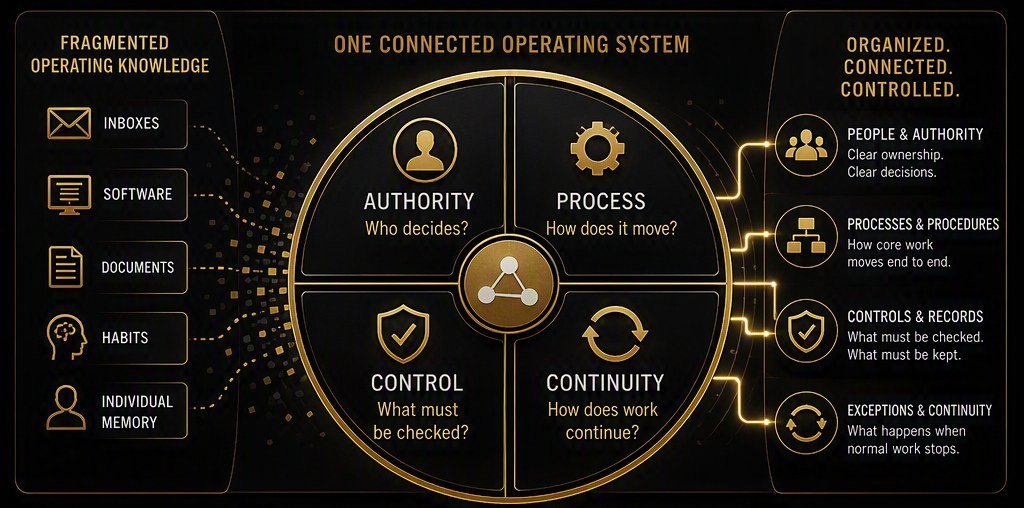
The Core Operations Manual assembles the operating baseline: who owns what, how core work moves, which procedures and records support it, which controls matter, and what happens when normal work stops.
Four questions hold the manual together. Every section answers one of them, and none of them can be answered in isolation — which is why the manual is a connected system rather than a stack of documents.
05 / Manual architecture
Roles, decision rights, approval, escalation, backups, management review, and accountability.
Major processes, inputs, outputs, dependencies, handoffs, completion criteria, procedures, and records.
Approval gates, quality controls, change controls, recordkeeping, monitoring, and corrective action.
Triggers, alternate work, authority, communications, recovery, follow-up, and lessons returned to the baseline.
06 / From capture to independence
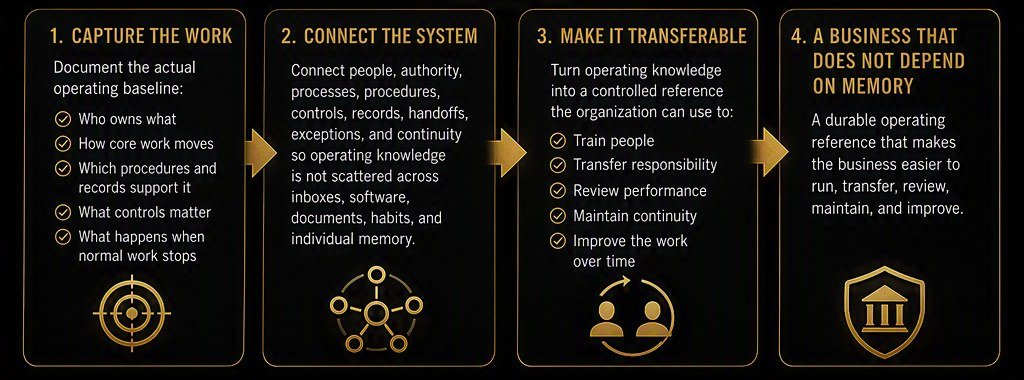
Capture the work as it actually runs. Connect it into one system. Make it transferable. What remains is a durable operating reference — and an organization that can hand the work to someone new without handing over a person.
07 / Method
// The manual is written from the operation as it runs, not from an idealized version of it. Where practice and procedure disagree, both are recorded before either is changed.
08 / The deliverable
09 / Who it serves
Capture what one person knows before the notice period becomes the documentation project.
Give new people a real operating reference instead of a shadowing rotation and a folder of half-current files.
An operation documented as a system reads very differently from one that lives in the founder’s head.
Establish authority, controls, records, and exception handling before an external reviewer tests them.
10 / Service ladder
11 / Clear boundaries
The customer approves the content, operates the procedures, trains its people, maintains controls, and keeps the manual current.
Scope varies with functions, document volume, process complexity, sites, evidence, stakeholder time, and implementation depth.

12 / The investment
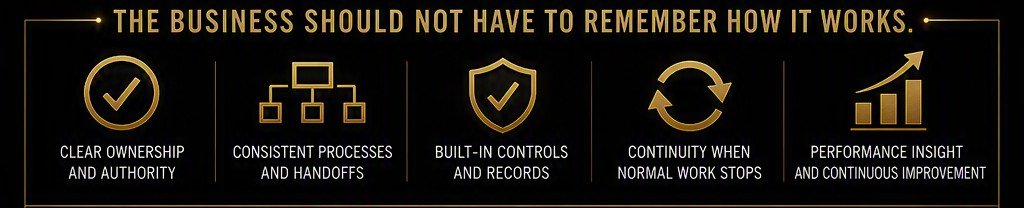
A defined baseline covering organization, authority, core processes, procedures, controls, records, exceptions, and continuity. Scope varies with functions, document volume, process complexity, sites, evidence, stakeholder time, and implementation depth.
// ORGANIZED / CONNECTED / CONTROLLED
13 / Common questions
No. It is a connected manual architecture and document set. The final structure can use linked procedures and supporting records rather than one unreadable file — a manual nobody opens is not a control.
Continuity, exception, recovery, and emergency operating content can be included within the defined scope. That is the fourth quadrant of the architecture, not an appendix.
Yes. The manual can become the source for role references, job aids, training material, and onboarding — which is usually where the return shows up first.
That gap is a finding, and it is common. The manual is written from the operation as it actually runs, with the discrepancy recorded, so leadership can decide whether to change the practice or change the procedure.
This establishes the operating record: authority, process, control, and continuity documented as a connected reference. The Controlled Operations System goes further and builds the governed system around it — responsibility, evidence, and review as an operating discipline. Start here when the need is the record itself.
Functions, locations, process count, document volume, stakeholder complexity, evidence, workshops, and revision depth.
14 / The decision
Bring the operating knowledge that currently lives in too many people, systems, and fragments.
Start the conversation →$12,500 Operating record
Talk to us