01 / Services / Defined Process Map

Formal procedures describe what should happen.
This establishes what actually does.

A bounded current-state map for one clearly defined workflow, validated with the people who perform it.

Capture the trigger, inputs, steps, decisions, ownership, handoffs, exceptions, controls, delays, records, and outcome that make the process what it is.

Defined Process Map / Starting at $1,500

02 / The premise

A clean diagram is not enough. Make the work visible. Then decide.

The map creates a shared operating artifact before automation, SOP writing, training, or redesign begins.
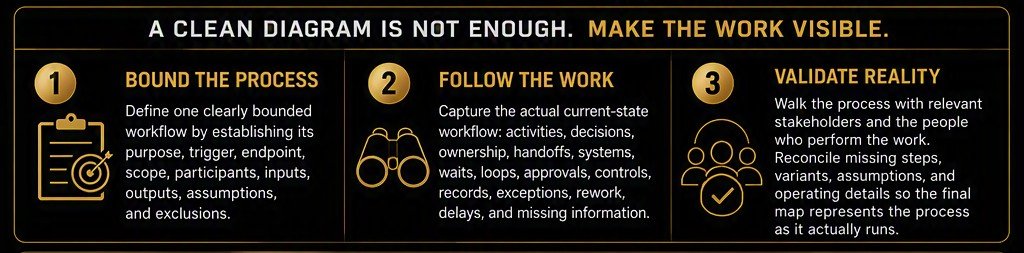
A clean diagram is not enough. Make the work visible. One, bound the process: define one clearly bounded workflow by establishing its purpose, trigger, endpoint, scope, participants, inputs, outputs, assumptions and exclusions. Two, follow the work: capture the actual current-state workflow including activities, decisions, ownership, handoffs, systems, waits, loops, approvals, controls, records, exceptions, rework, delays and missing information. Three, validate reality: walk the process with relevant stakeholders and the people who perform the work, reconciling missing steps, variants, assumptions and operating details so the final map represents the process as it actually runs.

03 / Operating signals

01Bounded
workflow
13Captured
elements
05Method
stages
02Correction
rounds

04 / The operating question

What actually happens between start and done? Follow one path.

Formal procedures often describe intent. Performers know the real sequence, workarounds, waits, decisions, and rework that occur in practice. This engagement establishes one bounded process as it runs today, then validates the model with relevant stakeholders.
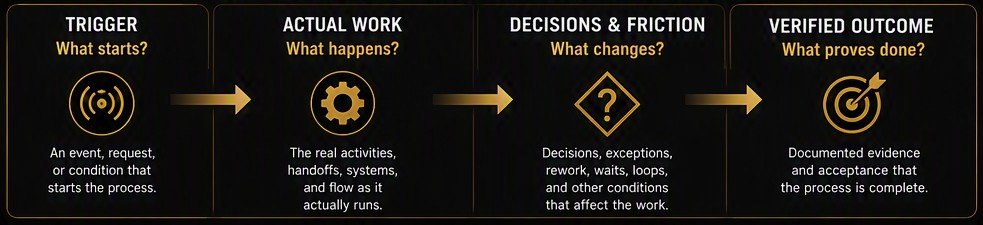
The Defined Process Map makes the real work visible across four stages. Trigger: what starts? An event, request, or condition that starts the process. Actual work: what happens? The real activities, handoffs, systems and flow as it actually runs. Decisions and friction: what changes? Decisions, exceptions, rework, waits, loops and other conditions that affect the work. Verified outcome: what proves done? Documented evidence and acceptance that the process is complete.
Trigger → actual work → decisions and friction → verified outcome.

The four questions are deliberately blunt. Most process documentation answers the first and the last, then leaves the middle to assumption — which is exactly where cost, delay, and rework accumulate.

A map that records only the approved route is a description of intent. A map that records the waits, the returns, and the informal authority is a description of the operation.

05 / What a finished map looks like

One bounded process. Every lane, wait, and return on the record.

Below is an illustrative current-state map: a customer request moving to order fulfillment across six lanes. Note what a conventional flowchart leaves out — the two-day supplier wait, the manual status update, the exception path to an alternate supplier, and the loop back for more information.
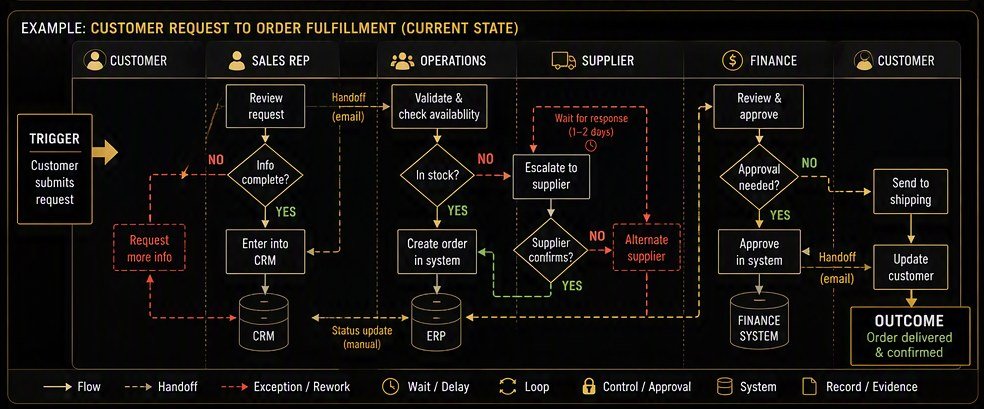

Example current-state map: customer request to order fulfillment. Six lanes for customer, sales rep, operations, supplier, finance and customer. A trigger of customer submits request flows to review request, then an info complete decision that either loops back to request more info or proceeds to enter into CRM. Operations validates and checks availability, an in stock decision either creates the order in the system or escalates to supplier with a one to two day wait, and a supplier confirms decision that may route to an alternate supplier. Finance reviews and approves, an approval needed decision routes to approve in system or send to shipping, and the customer is updated. The outcome is order delivered and confirmed. The legend marks flow, handoff, exception or rework, wait or delay, loop, control or approval, system, and record or evidence.
Illustrative current state — your map is built from your operation.
What we capture: activities, decisions, ownership, handoffs, systems, waits, loops, approvals, controls, records, exceptions, rework, delays, and missing information.

06 / What becomes visible

Map more than boxes and arrows. Capture the operating detail.

// BOUNDARY

Trigger and endpoint.

Define purpose, start condition, completion, customer, supplier, scope, and exclusions.

// FLOW

Steps and decisions.

Capture activities, decisions, waits, loops, approvals, and standard sequence.

// PEOPLE

Role and ownership.

Identify the people performing, approving, receiving, escalating, and closing work.

// REALITY

Exceptions and friction.

Record workarounds, rework, handoff problems, delays, controls, and missing information.

Intended process: what should happen. Current state: what actually happens.

07 / Method

Current state first. Improvement after reality. Validate the map.

01 / SCOPEBound
02 / DISCOVERListen
03 / MAPCapture
04 / VALIDATEWalk
05 / DELIVERExplain
  • Scope. Set the process boundary, intended use, participants, evidence, and level of detail.
  • Discover. Review supporting artifacts and listen to the people who perform the work.
  • Map. Represent the current workflow, decisions, handoffs, systems, exceptions, and records.
  • Validate. Walk the draft with stakeholders and reconcile missing steps or variants.
  • Deliver. Provide a maintainable map, notes, assumptions, glossary, and visible improvement candidates.

08 / The deliverable

Give one process a shared operating picture. Make the next decision easier.

  • Process charter. Purpose, trigger, endpoint, scope, assumptions, and intended use.
  • Context frame. Suppliers, inputs, outputs, customers, constraints, and measures where useful.
  • Current-state map. Validated workflow at the agreed level of detail.
  • Responsibility view. Roles, ownership, approvals, handoffs, and escalation points.
  • Friction register. Delays, duplication, rework, missing information, control gaps, and improvement candidates.
  • Editable source. Maintainable source with two consolidated correction rounds.
Final outcome: a validated current-state operating picture that makes the process, ownership, decisions, handoffs, friction and outcome visible. One clearly bounded process. Captured as it actually runs. Validated by the people who do the work. Shared, trusted, and ready for informed decisions.

10 / Clear boundaries

The map represents the work. It does not silently become a redesign. Keep scope visible.

// CURRENT STATE

Reality before ideal.

Current-state mapping comes first. Future-state design, SOP development, automation, and implementation are separate scopes unless explicitly included.

// INVESTMENT

From $1,500.

Price varies with process depth, stakeholder count, evidence, systems, branches, field observation, and reporting requirements.

11 / The investment

Start with one process you can actually finish. Starting at $1,500.

Defined Process Map / Starting at $1,500

The entry point to the mapping ladder. Scope varies with process depth, stakeholder count, evidence, systems, branches, field observation, and reporting requirements.

Scope the map →

// ONE BOUNDED PROCESS / CAPTURED AS IT RUNS / VALIDATED BY THE PEOPLE WHO DO THE WORK

12 / Common questions

Make the process clear enough to use. Ask directly.

Is this just a flowchart?

No. It includes scoping, performer-led discovery, current-state capture, validation, exceptions, ownership, and editable source. A flowchart shows the approved route; this records the waits, returns, and informal authority that the route leaves out.

Do you include the happy path?

Yes, and known decisions, delays, rework, exceptions, handoffs, and controls within the agreed boundary. The happy path alone would not be worth mapping.

How many processes are included?

The baseline is one clearly bounded workflow. Additional processes or expanded boundaries are separately scoped.

Are revisions included?

Two consolidated correction rounds are included. New branches or material scope expansion may change the investment.

What if the people disagree about how the process runs?

That disagreement is one of the more useful things the map surfaces. The draft is walked with the people who perform the work, and where accounts differ the variants and assumptions are recorded rather than quietly resolved.

Which map should we start with?

Start here when the work sits inside one team with a manageable number of branches. Move to the Cross-Functional Map when the work crosses several teams, and to the Complex Process & Responsibility Map when authority, variants, and exception paths are the difficulty.

13 / The decision

See the work. Then improve it. Start with one process.

Bring the workflow that is important enough to map and simple enough to begin.

Start the conversation →

Starting at $1,500 One bounded workflow

Talk to us
