01 / Services / Documentation & Gap Review
A document existing does not mean the requirement is covered.
Test what actually operates.
A structured review of operational documentation, records, controls, and implementation against an agreed requirement set.
We distinguish an absent document from an incomplete procedure, an inconsistent record, a stale control, and a requirement that exists on paper but is not operating in practice.
Documentation & Gap Review / Starting at $5,000
02 / The premise
A document is not a control until the organization can use it. Test the difference.
The review gives leadership a traceable picture of what exists, what is missing, what conflicts, what is stale, and what deserves action first.
03 / Operating signals
04 / The review question
Do not ask only whether the document exists. Ask whether it works.
A useful gap review starts with a defined basis: a customer requirement, contract, insurer request, policy set, management-system standard, approved procedure, or other agreed operating baseline.
We inventory the material, test coverage and consistency, examine evidence where scoped, and connect findings to ownership, process, control, training, records, and implementation.
The result is a prioritized findings package rather than an undifferentiated list of missing paperwork.
05 / Five gap states
Name the type of gap. Not every gap has the same fix.
“We have a documentation problem” is not an actionable finding. An absent procedure needs authoring. A stale one needs revision. An unimplemented one needs operational change — and writing a new document would not touch the actual condition.
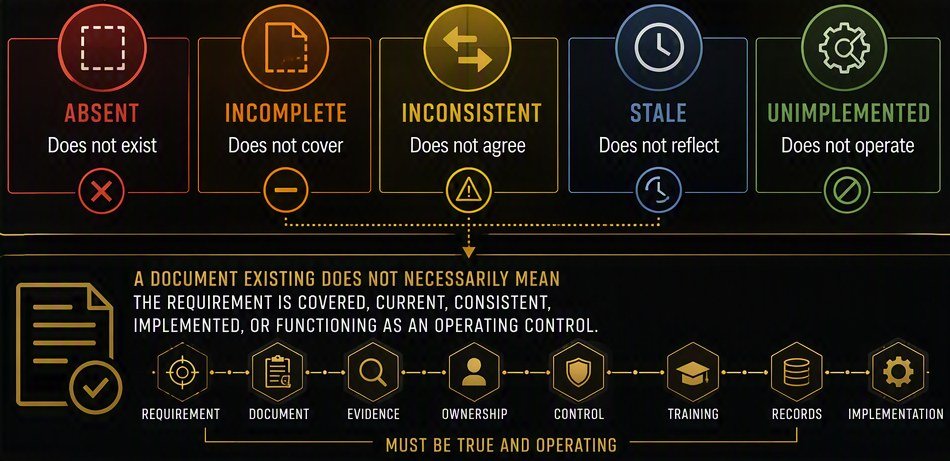
- Requirement
- Document
- Evidence
- Ownership
- Control
- Training
- Records
- Implementation
// Must be true and operating — a break anywhere in the chain is a finding
06 / Review domains
Documentation is a system of relationships. Review the connections.
Policy and ownership.
Management responsibility, approval authority, escalation, delegated responsibility, and review expectations.
SOPs and standard work.
Coverage, clarity, decision criteria, exceptions, supporting information, and process alignment.
Evidence and retention.
Forms, logs, completion evidence, traceability, availability, and retention expectations.
Training and competence.
Responsibilities, preparation, retraining triggers, completion records, and operating knowledge.
Checks and approvals.
Inspections, monitoring, corrective action, closure evidence, exception authority, and review steps.
Revision and document control.
Current versions, change history, superseded information, ownership, and review cadence.

07 / Method
Review against something defined, not against a consultant's mood. Make every finding traceable.
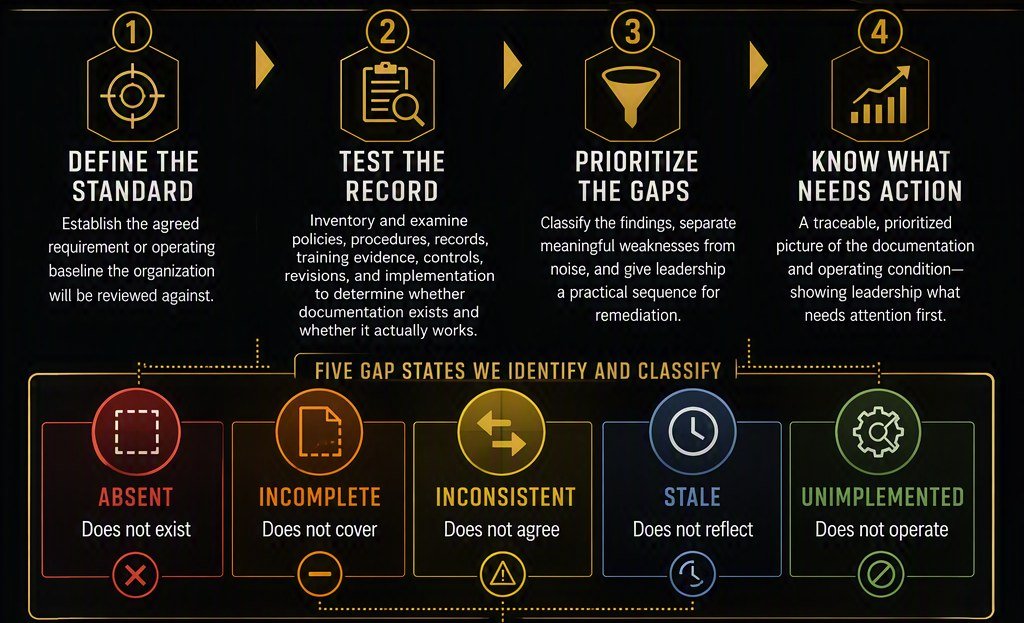
01 / SCOPEDefine
02 / CRITERIATranslate
03 / INVENTORYAccount
04 / REVIEWTest
05 / VERIFYClarify
06 / CLASSIFYPrioritize
07 / REPORTDeliver
- Scope. Identify the organization, process, location, document family, requirement set, stakeholders, date range, and exclusions.
- Criteria. Translate the agreed basis into clear evaluation criteria rather than generic good-practice language.
- Inventory. Account for policies, SOPs, forms, logs, training evidence, records, plans, prior findings, and supporting documents.
- Review and verify. Use document review, sample records, clarification, interviews, or walkthroughs when included in scope.
- Classify and report. Separate material gaps, important weaknesses, improvement opportunities, adequate controls, limitations, and next actions.
08 / The deliverable
Enough detail to know what to fix, without buying the fix twice. Use it Monday.
- Executive summary. Leadership-level condition, major findings, recurring themes, priorities, and recommended sequence.
- Criteria matrix. Traceable criteria, evidence reviewed, assessment status, and scope boundaries.
- Documentation inventory. Documents and records reviewed, including obvious ownership or version issues.
- Findings register. Finding statement, criterion, evidence, classification, related process, and recommended action.
- Remediation roadmap. Dependencies, ownership recommendations, and a practical sequence of work.
- Controlled final report. Draft clarification cycle followed by a final package documenting accepted corrections and limitations.
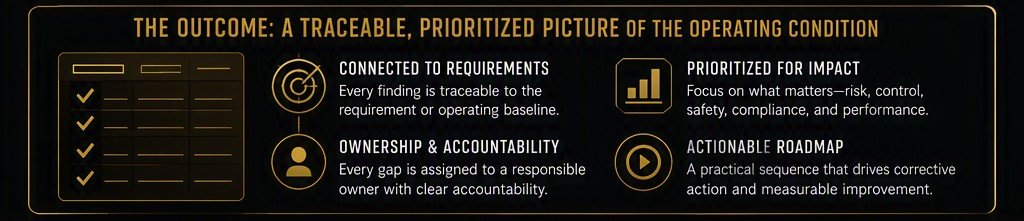
09 / Prioritized findings
Not every gap deserves the same response. Separate urgency from noise.
Material attention.
A significant requirement, control, evidence, or implementation gap that warrants prompt leadership attention.
Important weakness.
A meaningful deficiency or inconsistency that can weaken readiness, reliability, or control.
Planned improvement.
A lower-risk weakness, clarity issue, or maturity opportunity for planned remediation.
Adequate control.
Reviewed evidence reasonably supports the criterion within the defined review boundaries.
10 / Use cases
Know the condition before committing to the remediation. Start with the record.
Find weaknesses first.
Identify missing documents, stale controls, and weak evidence before an external review makes the discovery.
Prepare the operating record.
Understand documentation and control gaps before underwriting or loss-control requests become time-sensitive.
Reduce surprises in the review.
Identify weak process documentation, key-person dependency, and missing operating records.
Find systemic weakness.
Review whether procedures, training, records, escalation, and corrective action reflect what happened.
11 / Service ladder
Choose the unit of work that matches the question. Do not overbuy.
12 / Clear boundaries
Say what the evidence supports. Say what it does not. Keep the conclusion clear.
Findings are not promises.
The review identifies supported conditions and improvement opportunities. It does not guarantee savings, performance improvement, regulatory acceptance, or a particular business result.
Review is not remediation.
Writing missing documentation, implementing controls, training people, or rebuilding the operating system can be separately scoped.
13 / The investment
Know what is missing before paying to fix it. Starting at $5,000.
Documentation & Gap Review / Starting at $5,000Scope varies with requirements, locations, document volume, interviews, walkthroughs, historical records, implementation verification, and report depth.
// INDEPENDENT / EVIDENCE-DRIVEN / ACTIONABLE
14 / Common questions
A gap review is useful because it does not pretend the answer is already known. Ask directly.
Is this a regulatory audit?
No. It is a structured consulting review against an agreed basis and does not replace an authorized regulator, insurer, certification body, attorney, or specialist.
We have all the documents. Is there anything to find?
Often, yes — and that is the point of classifying gaps by type. A complete document set can still be inconsistent with practice, stale against current requirements, or documented but not operating. Existence is the beginning of the test, not the end of it.
Does it include fixing every gap?
No. The core product is the assessment and findings package. Remediation can be scoped separately after the condition is known.
Can it include walkthroughs?
Yes, where stakeholder clarification, sample records, interviews, or walkthroughs are included in the agreed scope. Implementation verification is what separates a documented control from an operating one.
How is this different from the Operational Effectiveness Audit?
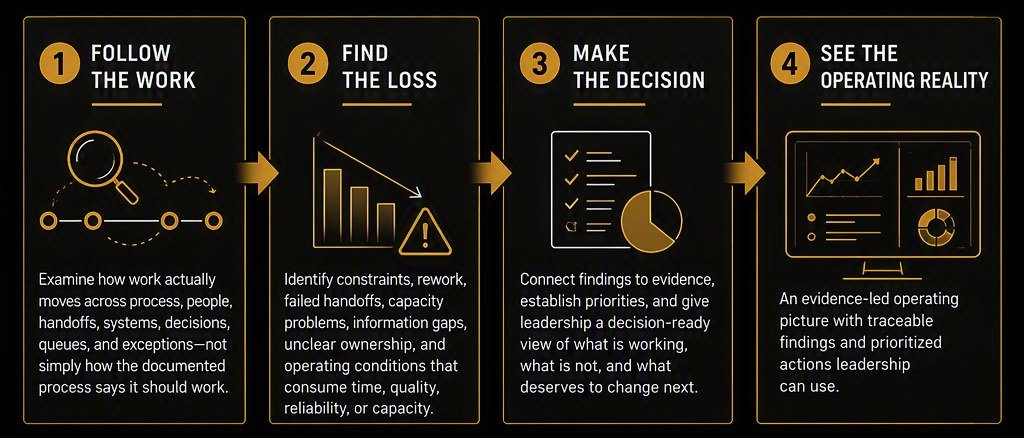
This review tests documentation, evidence, and implementation against a defined requirement set. The audit is broader — it follows how the operation actually performs across process, people, capacity, quality, measurement, and management response. Start here when the question is about the record; start there when the question is about the operation.
What causes the price to change?
Multiple sites or standards, large evidence sets, deep historical review, additional interviews, complex environments, or expanded reporting.
15 / The decision
Find the gap. Prioritize the work. Keep the evidence.
Bring the requirement, the documents, the operating question, and the decision leadership needs to make.
Start the conversation →