01 / Services / Multi-Site Audit Program

One standard. Many locations. See the difference.
Then know what it means.

A coordinated audit program for organizations that need a consistent method across sites without erasing local operating reality.

JLS establishes the common criteria, evidence model, field method, findings logic, and leadership view — while preserving the local conditions that explain why sites perform differently.

Multi-Site Audit Program / Starting at $15,000

02 / The premise

Consistency is not sameness. It is knowing what each site means. Compare the system.

The program gives leadership comparable evidence, local explanation, cross-site patterns, and a prioritized sequence for action.
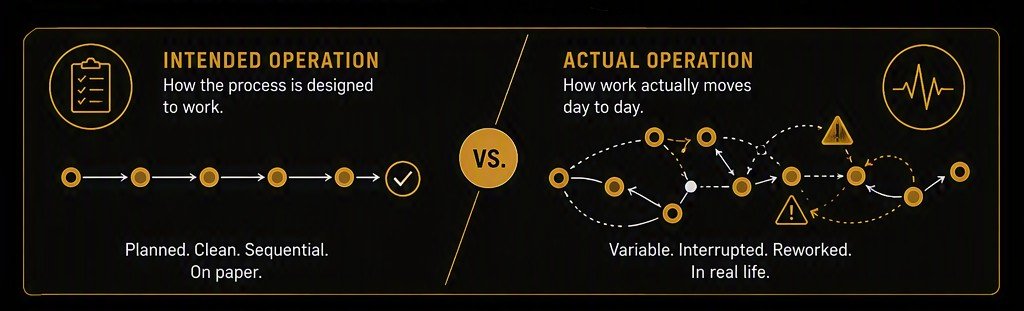
Intended operation versus actual operation. Intended: how the process is designed to work, shown as a clean sequential path. Planned, clean, sequential, on paper. Actual: how work actually moves day to day, shown as a variable interrupted path with rework loops and warnings. Variable, interrupted, reworked, in real life.

// Every site has both. The program's job is to find out which differences are explanations and which are findings.

03 / Operating signals

06Program
dimensions
07Method
stages
06Deliverable
artifacts
01Leadership
view

04 / The scale problem

A local finding can be a local issue, a shared weakness, or a system signal. Find out which.

Multi-site organizations often have a common policy and very different operations. A good program must make comparison possible without turning every difference into a failure.

We define the common audit frame, coordinate evidence collection, preserve site-level context, and bring findings back into a view leadership can use across locations.

The output is not a ranking for its own sake. It is a decision model for recurring weaknesses, strong local practices, resource needs, and system-wide action.

05 / Program architecture

Build one method that can survive local reality. Keep the signal.

// 01 / CRITERIA

Common requirements and meaning.

Define the shared criteria, terms, evidence expectations, and finding logic every site receives.

// 02 / SAMPLING

Comparable evidence and boundaries.

Set practical document, record, interview, walkthrough, and observation rules appropriate to each site.

// 03 / LOCALITY

Site context without excuses.

Capture staffing, equipment, demand, process, customer, regulatory, and facility conditions that affect the result.

// 04 / COMPARISON

Patterns across the network.

Separate isolated findings, recurring weaknesses, local strengths, and enterprise-level dependencies.

// 05 / RESPONSE

Action with ownership.

Assign recommended response by site, function, leadership layer, system owner, or shared service.

// 06 / FOLLOW-UP

Closure and recurrence.

Track corrective action, evidence of closure, repeated findings, and whether the system changed the condition.

06 / Method
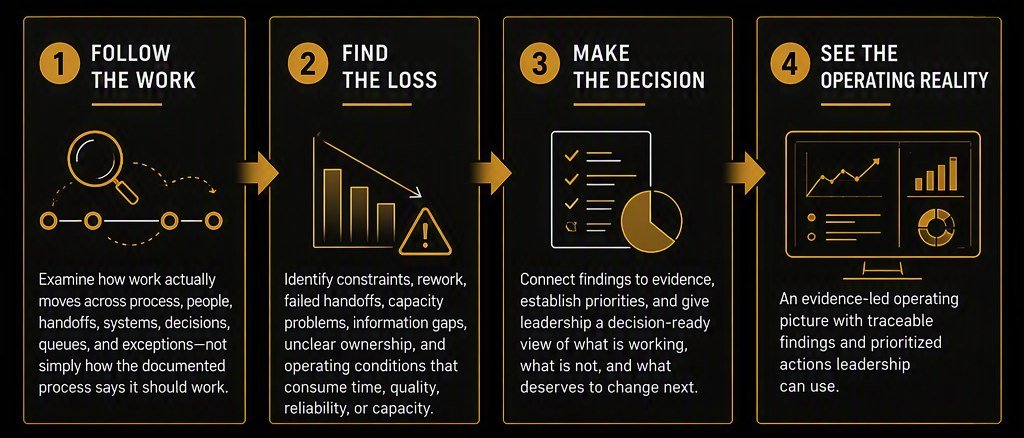
Coordinate the program. Preserve the evidence. Give leadership a view it can trust. Site by site.

Four stages. One, follow the work: examine how work actually moves across process, people, handoffs, systems, decisions, queues and exceptions, not simply how the documented process says it should work. Two, find the loss: identify constraints, rework, failed handoffs, capacity problems, information gaps, unclear ownership and operating conditions that consume time, quality, reliability or capacity. Three, make the decision: connect findings to evidence, establish priorities, and give leadership a decision-ready view of what is working, what is not, and what deserves to change next. Four, see the operating reality: an evidence-led operating picture with traceable findings and prioritized actions leadership can use.
The same four stages, run consistently at every site.
01 / DESIGNFrame
02 / ALIGNCalibrate
03 / COLLECTGather
04 / REVIEWAssess
05 / COMPAREConnect
06 / PRIORITIZESequence
07 / REPORTDeliver
  • Design. Define sites, scope, criteria, stakeholders, evidence, schedule, sampling, exclusions, and reporting.
  • Align. Calibrate terminology, interviewer expectations, evidence thresholds, and finding classifications.
  • Collect and review. Gather site records, documentation, interviews, observations, measures, and local context.
  • Compare. Identify common conditions, local variation, recurring weaknesses, strong practices, and shared dependencies.
  • Prioritize and report. Give each site useful feedback and leadership a network-level action sequence.

07 / The deliverable

Make every site visible without losing the pattern. Give action a home.

  • Program charter. Scope, criteria, sites, timing, roles, evidence model, sampling, exclusions, and decision questions.
  • Common audit instrument. Shared criteria, interview prompts, evidence expectations, finding language, and review controls.
  • Site findings packages. Local evidence, conditions, findings, priorities, strengths, limitations, and recommended action.
  • Cross-site comparison. Recurring themes, site differences, shared dependencies, local strengths, and enterprise signals.
  • Leadership dashboard. A concise view of material findings, ownership, status, recurrence, and priority response.
  • Action roadmap. Site, function, shared-system, and leadership actions sequenced with dependencies.
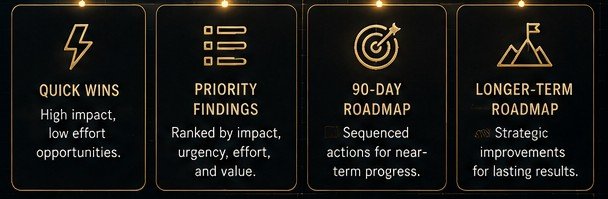
Four decision products: quick wins, high impact low effort opportunities; priority findings, ranked by impact, urgency, effort and value; a 90-day roadmap of sequenced actions for near-term progress; and a longer-term roadmap of strategic improvements for lasting results.
What the network findings become.
Comparison must explain difference, not erase context.

08 / Measurement

Measure the network without pretending every site is identical. Make comparison fair.

// CONDITION

Finding volume is not performance.

Read the number of findings alongside scope, evidence, complexity, and audit conditions.

// RECURRENCE

Repeat weakness needs a system response.

Track recurring themes and determine whether local action or shared architecture is required.

// CLOSURE

Closed is not the same as changed.

Review corrective-action evidence and whether the operating condition actually improved.

// CAPACITY

Prioritize the work the network can absorb.

Sequence action against ownership, resources, dependencies, urgency, and operational capacity.

10 / Clear boundaries

Comparison must explain difference, not erase context. Keep the result fair.

// LOCAL

Site conditions matter.

Staffing, demand, equipment, facility, process, customer, and local obligations are part of interpretation.

// PROGRAM

A program is not a guarantee.

The program creates comparable evidence and a response model. It does not guarantee compliance, savings, or identical performance.

11 / The investment

See the network clearly enough to act. Starting at $15,000.

Multi-Site Audit Program / Starting at $15,000

Scope varies with number of sites, audit depth, standards, evidence volume, field work, local complexity, travel, reporting, and follow-up.

Scope the program →

// ONE METHOD / LOCAL EVIDENCE / NETWORK-LEVEL ACTION

12 / Common questions

A multi-site program is valuable when it turns many local answers into one useful decision. Ask directly.

Does every site receive the same audit?

Every site receives the common method. The evidence, local context, and appropriate depth can differ within the agreed program design — that is the difference between consistency and sameness.

Will you rank the sites?

Comparison can be provided where meaningful, but the objective is useful action and system learning rather than a simplistic ranking. Finding volume read without scope, evidence, and complexity produces a league table that misdirects the response.

How do you stop this becoming a way to punish sites?

By treating local conditions as part of the interpretation rather than as excuses. Staffing, demand, equipment, facility, customer mix, and local obligations are captured with the findings, so leadership can tell a site problem from a system problem before assigning a response.

Can this include follow-up?

Yes. Corrective-action review, recurrence analysis, and closure evidence can be included or separately scoped. Recurrence is usually the most valuable signal the program produces.

How is this different from running the Effectiveness Audit at each site?

Separate audits produce separate answers in different languages. This program calibrates criteria, terminology, evidence thresholds, and finding classifications up front, so the results are genuinely comparable and the cross-site pattern becomes visible.

What changes the investment?

Site count, geography, evidence, standards, field observation, travel, stakeholder complexity, and report depth.

13 / The decision

See the pattern. Act at the right level. Keep local truth.

Bring the sites, the shared requirement, the recurring finding, or the network question leadership needs answered.

Start the conversation →

Starting at $15,000 Coordinated program

Talk to us